
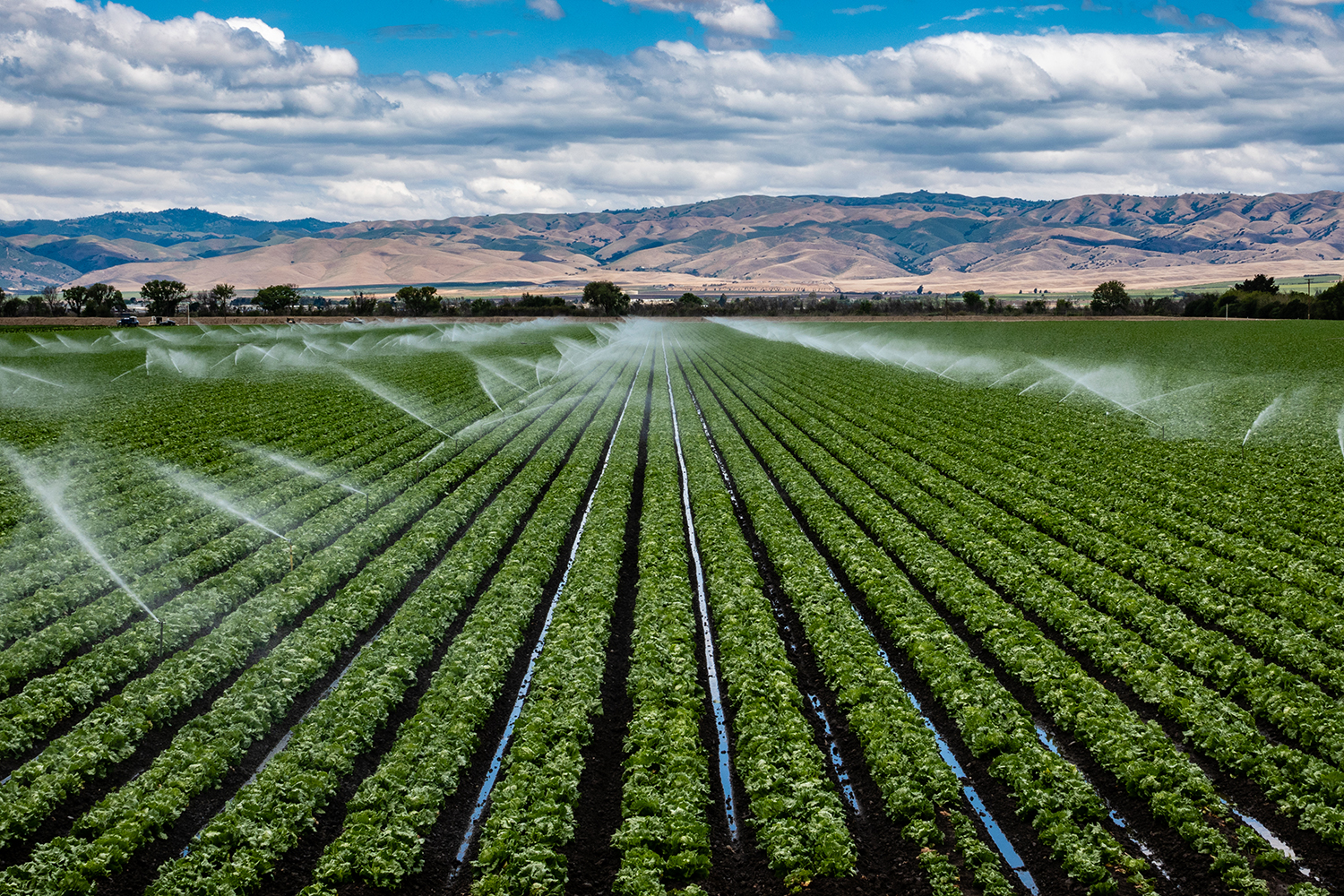
Drive through the Salinas Valley in almost any season and you’ll see it: mile after mile of lettuce, strawberries, and broccoli, tended by crews working before sunrise to keep the nation’s produce aisles stocked. It’s easy to take for granted. It shouldn’t be. Agriculture isn’t just part of the Monterey Bay region’s identity — it’s the backbone of its economy, generating well over $11 billion a year and supporting tens of thousands of local jobs, either directly on farms or through the packing houses, trucking companies, and equipment dealers that depend on them. Roughly one in every five jobs in Monterey County traces back to agriculture in some way.
That scale is also what makes the region vulnerable. Two forces in particular — public health scares and shifting trade policy — can shake this economy in ways that ripple far.
Start with public health. The Salinas Valley grows a majority of the nation’s leafy greens, which means it has also been at the center of some of the most disruptive E. coli outbreaks in recent memory. When health officials trace an outbreak back to “Salinas Valley romaine,” the recall doesn’t distinguish between the farm responsible and the hundreds of others growing the same crop safely a few miles away. Sales stop. Contracts get renegotiated or canceled. Workers see fewer hours. Even after the outbreak clears, consumer wariness can linger for months, and buyers sometimes shift orders to competing growing regions in Arizona or Mexico that may not come back once the crisis passes. Stronger traceability and food-safety systems, developed in the years since the major 2018 and 2019 outbreaks, have helped. But the underlying risk — open-field crops irrigated with water that can carry contamination — is not one the industry can fully engineer away, which means the threat of another headline-driven shock is always present.
The pattern is playing out again right now. The largest cyclosporiasis outbreak in U.S. history is underway this summer, with more than 1,600 confirmed cases nationwide as of late July — well above what health officials would normally expect for this point in the season. Investigators traced one cluster to iceberg lettuce, prompting Salinas-based Taylor Farms to recall product and pull all iceberg lettuce sourced from a region of central Mexico, even though FDA traceback pointed to a single farm representing less than 1% of the country’s iceberg supply. No dollar figure has been published yet for this outbreak’s toll, but the 2018 romaine E. coli outbreak offers a preview of what’s typically at stake: Romaine sales fell nearly 45% within a month, iceberg sales dropped over 20%, and one retail food-safety executive estimated cleanup costs alone could run into the millions. A Salinas company can end up absorbing that kind of reputational and financial hit even when the contaminated product never touched Salinas Valley soil — a reminder that in this industry, one company’s crisis becomes the whole region’s headline.
Trade policy cuts just as deep, if more slowly. Because fresh produce moves on thin margins and short shelf lives, tariffs and retaliatory trade measures land quickly. Recent U.S. tariff actions have so far spared fresh produce from Mexico and Canada under United States-Mexico-Canada Agreement (USMCA) exemptions, sparing the valley the worst-case scenario for now. But that exemption is not permanent, and it sits inside a broader trade environment that growers describe as unusually uncertain: tariffs still apply to imports from some countries, a Supreme Court ruling this year complicated the legal basis for several existing tariffs, and the pending 2026 USMCA review could reshape the rules again. For higher-value crops like strawberries, and for the equipment and export markets growers rely on, that uncertainty alone raises costs and complicates the long-term planning agriculture requires.
None of this argues for panic. It argues for recognizing what’s actually at stake. When a recall or a tariff dispute makes national news, it’s easy to read it as an abstract policy story. Here, it’s a local jobs story, a local tax-revenue story, and for many families, a household-income story. Supporting the food-safety infrastructure that protects consumers, while pushing for trade policy that accounts for how quickly perishable agriculture can be hurt by disruption, isn’t a niche concern. It’s economic self-interest for an entire region.