
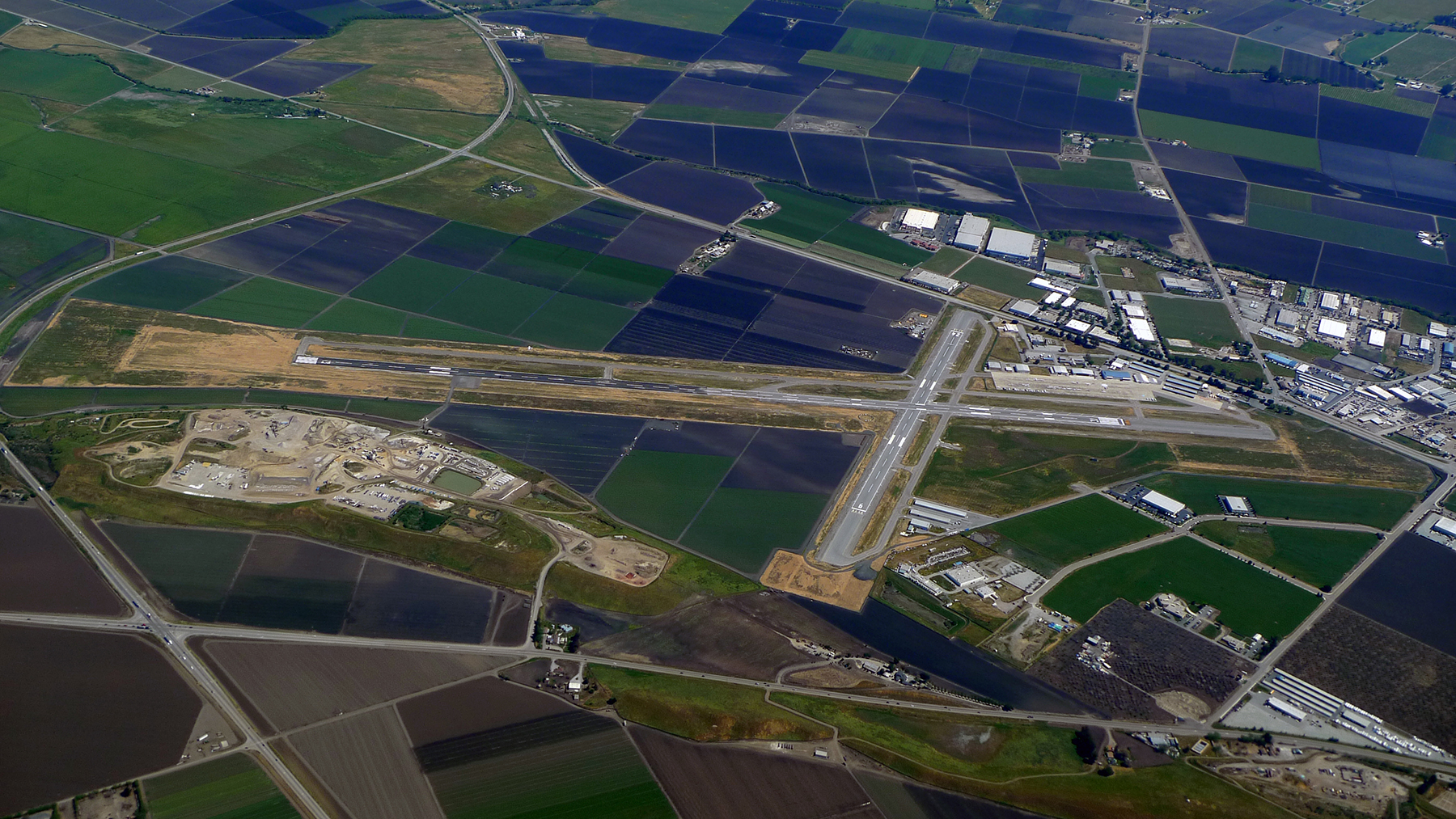
Understanding the Big Impact of a Small Airport on the Regional Economy

(July 31, 2026 — Marina, CA) — The recently released Hollister Municipal Airport Economic Impact Study gives a detailed look at the impact a small, rural airport can have on the residents, businesses, and visitors in a region. Commissioned by the city of Hollister and conducted by the firm Kimley-Horn, the study determined that, in 2024, the airport generated $40.9 million in economic output.
In a Q&A with MBEP, Hollister Airport Director Jeff Crechriou shares insight into how advanced air mobility factors into future growth, how that drives new investment in the region, and how the California Advanced Air Mobility Corridors Initiative (CAAMCI) is creating new opportunities for residents and positioning the region as a leader in innovation.
Q. This economic impact study captures a specific moment in time — 2024. What kind of growth has occurred since then?
A. Hollister Municipal Airport has experienced growth from the Advanced Air Mobility (AAM) and Unmanned Aircraft Systems (UAS) industry. Examples: Wisk Aero is set double the daily workforce at the Airport of 2024 in 2026; the City and FAA approved a Through the Fence Access Agreement for Joby Aviation to utilize a lot/building in the Hollister Airpark Business Center for locating flight testing program and will conduct flight testing activities from the airport in August 2026; the city approved an Airport Use Agreement in October 2025 for ALEF Aeronautics “ALEF Flying Car” to conduct flight testing activities at the airport.
Q. How would you predict a snapshot of 2026 might differ?
A. In 2026, I would predict Economic Output would be approaching $45 to $50 million.
Q. The new economic impact report illustrates just how broadly an airport can impact a region. Jobs are probably what most people think of as an economic benefit: Hollister Municipal Airport generates employment, such as mechanics, pilots, cashiers, technicians, and many other types of jobs. But this report makes clear that there are so many other ways it has an economic impact: Car rentals. Fuel sales. Real estate values. What are some of the other ways CVH influences our regional economy?
A. I believe positive news about the airport, such as Joby Aviation and ALEF Flying Car utilizing the airport for flight testing activities, attracts interest from all types of businesses in the city of Hollister and San Benito County region. Positive news about the airport may attract curiosity and interest in the greater Monterey Bay region.
Q. How are advancements in air mobility driving construction and capital improvement expenditures? What does that mean for the airport and for the regional economy?
A. As the advanced air mobility industry continues to make advancements, companies are expanding operations and have specific needs to support the flight testing, proof of concept and/or research and development activities. Currently, this emerging technology market has manifested in building remodel projects, proposed construction of large buildings with office and hangar space, and proposed new on-airport infrastructure such as a vertiport.
Q. How much of that is already reflected in this report, and could we measure those factors at this particular moment?
A. Much of this new demand and the proposed construction and new infrastructure has been realized in 2025 and first half of 2026. If we measure the factors, this indicates companies are expanding or locating operations in Hollister; thus, the prediction of increased economic output of the airport should trend in the $45 million to $50 million range.
Q. The study cites 16 reliant and 130+ potentially reliant off-airport businesses, with a combined economic output of $6.6 million. Can you share some examples of those enterprises? How might either the types or quantities of airport-reliant businesses evolve as air transportation and advanced air mobility continue to evolve?
A. We used a survey to identify specific businesses that use Hollister Airport and the ESRI Business Analyst tool to identify 130+ potentially reliant businesses in 16 commonly reliant industries. Some examples of businesses that responded to the survey include local construction and insurance companies, including RDL Construction and WHJR Associates, that use the airport to transport customers and personnel. Others were aviation operators (flight schools, charter or maintenance operators, etc.) located at other airports who fly to or use Hollister.
Reliant industries identified in the Business Analyst tool include local agricultural growers, technical and engineering services firms, and scientific research and development (which includes AAM manufacturers). Our methodology made assumptions about the percent of each of these industries that rely on aviation rather than individual businesses, so I can’t give examples of specific companies. The tool also identifies the number of businesses in an industry in a given geographic area, which is how we calculate 130 businesses.
Q. There’s an interesting convergence of past, present, and future that jumps out of the report: Having a company such as Wisk Aero on site, using CVH as a primary testing and prototype assembly location, is generating attention as a driver of good-paying jobs and putting a spotlight on the region for its support and role in growing the advanced air mobility (AAM) industry. Your airport is also home to Vintage Wings and Wheels, highly specialized for restoration and maintenance work on historic, pre-1950s aircraft from around the world. And the airport also hosts CAL FIRE’s Air Attack Base, which conducts year-round aerial firefighting, search-and rescue, and emergency response operations for the Monterey Bay Area and other regions in Central California – very much an immediate, current need in today’s wildfire climate. Is there value in helping our region understand the roles CVH plays in our region beyond the obvious role as an economic driver?
A. Absolutely. As a public-use general aviation airport, the airport should serve the needs of as many users as possible. CVH really shines in the variety of users: based aircraft operators, itinerant (visitor) aircraft operations, based glider operations, based specialty aviation services such as Vintage Wings and Wheels, Mingh Jet (The company focuses on the custom build, restoration, maintenance, and modification of vintage jet warbirds, providing services for aviation enthusiasts looking to purchase, refurbish, upgrade, or race their own private aircraft), flight training, full Fixed Based Operator (FBO) services by Hollister Jet Center, Critical Public Safety Mission with Cal Fire Air Attack Base and AAM flight testing, proof of concept and research and development activities.
Q. Hollister Municipal Airport is one of four airports participating in the California Advanced Air Mobility Corridors Initiative (CAAMCI). Looking ahead, how do you see participation in CAAMCI helping strengthen economic development opportunities not only for Hollister, but for the broader Monterey Bay region?
A. Through participation in CAAMCI, the region should have an opportunity for AAM and UAS companies to utilize a flight track connecting the four municipal general aviation airports (Hollister, Marina, Salinas, and Watsonville) to support flight operations for research and development, for proof of concept and for FAA certification. Companies that progress in research and development, proof of concept, and certification for commercial operations should increase good, high-paying, and career-type jobs in the tri-county (Monterey, San Benito and Santa Cruz) region. Further economic development should manifest in the form of workforce development and expanded courses and training through local education institutions throughout the region.
Q. CAAMCI is designed to demonstrate how airports can work together as a connected regional network rather than as individual facilities. What excites you most about that regional approach, and how could it position the Monterey Bay region as a leader in innovation and economic competitiveness over the next decade?
A. The regional approach highlights how our region is uniquely positioned to capitalize on the four general aviation airports and the emerging technology AAM and UAS market, and our regional constituents will have opportunities to be employed with companies in this market right here in our region. I believe this is a greater opportunity due to the regional approach of CAAMCI.
Q. When people hear “advanced air mobility,” they often think first about the aircraft themselves. What are some of the real-world community and economic benefits that initiatives like CAAMCI could bring to residents, businesses, healthcare providers, educational institutions, and local governments throughout the region?
A. For residents, increased access to high-paying, career-type employment opportunities. Increased employment means more consumers of existing businesses. Healthcare providers could expand and improve personal care through utilization of AAM and UAS technology like AAM air ambulances, AAM flights to bring patients and doctors together and UAS flights to perform home delivery of medicines, medical test kits, and small medical devices. Educational institutions should capitalize on workforce development through expansion of their course offerings and partnering with OEMs for training programs. Local governments should realize more financially sustainable airports and increased ancillary revenues such as increased sales tax and increased property taxes.
About Monterey Bay Economic Partnership (MBEP): Monterey Bay Economic Partnership (MBEP) is a regional member-supported nonprofit organization consisting of public, private, and civic entities located throughout the counties of Monterey, San Benito, and Santa Cruz. Founded in 2015, our mission is to improve the economic health and quality of life in the region.
Photograph by Don Ramey Logan, CC BY 4.0, https://commons.wikimedia.org/w/index.php?curid=39254193