
Across the agricultural heartlands of California, a quiet transformation is underway—one that is dismantling long-standing educational and industrial silos. Led by UC ANR Innovate, the AI Institute for Next Generation Food Systems (AIFS), and coordinated regionally by the Monterey Bay Economic Partnership (MBEP), the Farm Robotics Challenge is reimagining how students prepare for the workforce. By connecting student developers with local growers, the national initiative pushes multidisciplinary teams to tackle urgent, real-world farm problems using artificial intelligence, computer science, and engineering.
A prime example of this cross-disciplinary synergy unfolds in Monterey County, an agricultural powerhouse where crop production, processing, and economic multipliers contribute $11.7 billion to the local economy. At Hartnell College—home to one of California’s only agricultural mechatronics programs—a team known as “Iron Claw Robotics” spent the past year obsessing over a notoriously tough question: How do you better monitor and grow a thistle?
That thistle is the artichoke, California’s official state vegetable and the crown jewel of Castroville-based Ocean Mist Farms, North America’s largest grower of fresh artichokes. Artichokes are vital to the region’s $4.82 billion agricultural economy, yet the tedious harvesting process has remained virtually unchanged for a century. Skilled workers walk dense, muddy rows, using knives to manually slice mature buds two inches below the base before dropping them into heavy backpacks called canastas, which can weigh up to 100 pounds.
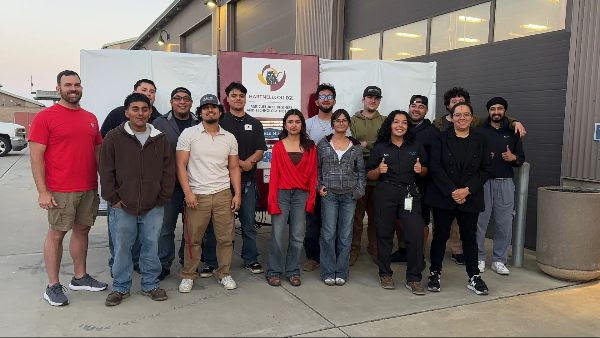
To address this labor-intensive process, Hartnell’s Iron Claw Robotics team partnered directly with Ocean Mist Farms. Under the guidance of agricultural engineering professor Richard Chapman, the team brought together students from diverse fields, including computer science, mechanical engineering, electrical engineering, and agricultural mechatronics. Together, they designed an autonomous crop monitoring system custom-built for dense artichoke fields.
Hartnell has been participating in the challenge since its inception four years ago.
“In that first year, we were the only community college in the nation to participate, and we were competing against top universities, with graduate-level research students,” says Chapman. “We were out of our league, and that’s not a bad thing.”
As interest in the program has grown, the Farm Robotics Challenge has since expanded to include international teams and a division specifically for community colleges.
Building a robot for artichokes requires navigating broad, bushy leaves and uneven terrain. Mounting their technology onto an “Amiga”—a lightweight, modular electric tractor developed by Farm-ng (now Bonsai Robotics)—the team engineered a slim, tall frame weighing 600 to 700 pounds. Hartnell was the first community college in the nation to own such equipment, said Chapman. The custom rig carries a battery of high-tech hardware: an onboard AI computer, machine learning algorithms, high-resolution cameras, lighting arrays, and precise GPS navigation. By driving through the fields alongside farm supervisors, the robot collects real-time visual and spatial data, paving the way for automated yield prediction, improved field inspections, and smarter data-driven farming.
Crucially, projects like these address one of the ag industry’s greatest fears: job displacement. Far from eliminating human labor, farm automation seeks to add dignity and safety to agricultural work. The Salinas Valley faces persistent labor shortages, an aging workforce, and rising living costs. As Chapman notes, automating field inspections and crop analysis reduces backbreaking physical wear on harvesters while opening pathways for farmworkers to upskill into higher-paying technical roles operating and maintaining robotics equipment.
The impact of breaking down academic silos extends directly into career development. Hands-on experience with real growers, industry mentors, and venture partners such as Reservoir Farms and Western Growers allows students to get their boots dirty while building workforce-ready skills. Members of Hartnell’s team have leveraged their competition experience into internships and full-time engineering roles at companies like Joby Aviation and PlantTape.
Hartnell’s team has kept the same project since 2022, building upon its work each year.
“We’ve gone from a point of ‘can we build a frame’ in the first year, to ‘can we record some pictures,’ then ‘how can we record more reliable data and utilize machine learning,’ “ he said.
This year, the team will design an entirely new frame for greater stability in the field.
But while the project has remained consistent, the team’s composition can change each semester, and many students also hold down full–time jobs. Some commuted from as far away as King City and Greenfield. Despite those challenges, Chapman said this year had the lowest team turnover, with an enthusiastic team, and the college was able to support them with paid internships.
The technology and the opportunity is unmatched: Hartnell was the first community college in the nation to own an Amiga tractor, and
“This is your playground,” Chapman tells them. “You can spend as much time here as you want, to figure this out.”
Now expanding into high schools through the Farm Robotics Academy, the Farm Robotics Challenge continues to prove that when computer science, mechanical engineering, and traditional agriculture unite, the result is a resilient, technologically empowered future for farming.
Photo courtesy of UC ANR