
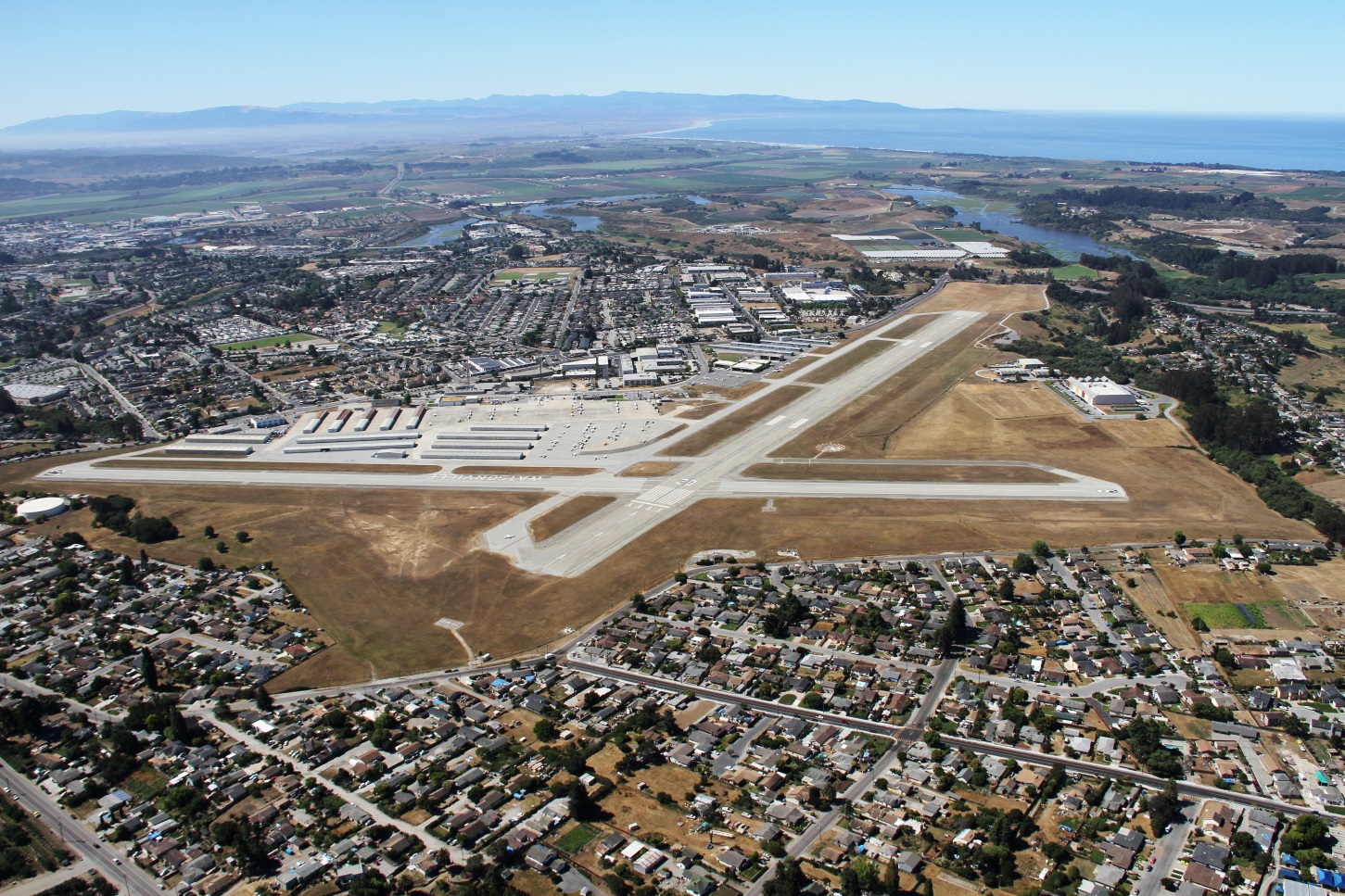

The Watsonville Municipal Airport Economic Impact Study highlights the many ways a community airport supports the regional economy. In 2024 alone, WVI generated $78.5 million in economic output and supported 482 jobs, demonstrating that airports are about far more than aviation — they’re engines of economic opportunity and community resilience.
In a Q&A with MBEP, Watsonville Municipal Airport Director Rayvon Williams shares insight into how advanced air mobility factors into future growth, how that drives new investment in the region, and how the California Advanced Air Mobility Corridors Initiative (CAAMCI) is creating new opportunities for residents and positioning the region as a leader in innovation.
Q. What has changed since the 2024 economic-impact study?
A. The 2024 study is a solid baseline, but it captured the airport at one moment in time. Since then, the airport hasn’t been standing still. We’ve kept investing in infrastructure and equipment, improving facilities, and expanding what we can do operationally, while also seeing new activity on the field and more attention on what Watsonville can add to the region’s aviation economy. One big shift is the scope of the conversation. We’re no longer talking only about “traditional general aviation.” Watsonville is increasingly part of a broader regional discussion that includes advanced air mobility, newer aviation technologies, workforce development, and practical ways aviation can connect communities. At the same time, we’ve been leaning into the airport as a community resource. Community events and aviation education have grown, we’ve welcomed new commercial activity, like Woody’s at the terminal, and we’ve continued working with tenants and users to bring airport policies and day-to-day operations up to date. So if we were to measure economic impact right now, I’d expect a wider story. The core economic activity is still there, but it’s now alongside technology development, workforce training, education, and deeper regional coordination.
Q. Beyond aviation jobs, how does the airport contribute to Santa Cruz County and the Monterey Bay region?
A. An airport’s impact isn’t confined to the people in the terminal or driving a fuel truck. It also shows up in the businesses that rely on aviation, the visitors who arrive by air, agri-business operations that depend on aircraft, the contractors and vendors supporting airport activity, and the spending that ripples through the surrounding community. Watsonville is a general aviation airport, but it serves a wide mix of users. Agriculture, business aviation, flight training, maintenance, emergency services, recreation, aviation education, and, more and more, aerospace innovation, all have a place here. We support hundreds of aircraft and see more than 60,000 operations each year. And the benefit doesn’t stop at the fence line. A company doesn’t need to sit on airport property to gain from having an airport nearby. If the airport helps a business reach customers, move personnel, support agriculture, respond to an emergency, or draw new investment to the region, the value spreads well beyond the airport itself.
Q. How do traditional roles evolve alongside advanced air mobility?
A. I don’t view advanced air mobility as something that pushes out the airport’s existing mission. It’s better understood as an added layer of activity that we have to bring in carefully and responsibly. Agriculture will still need aviation. General aviation will still matter. Flight training, business flying, emergency response, and recreation aren’t going away. What’s changing is that we’re seeing technologies emerge that open up new uses for aviation. The priority is not building a “future” that leaves behind the users who helped make Watsonville what it is. We want a place where today’s aviation can keep working and growing, while the next generation of technology also has room to take shape. That’s the job of airport management, keeping today’s infrastructure and services dependable, and making sensible choices that let tomorrow’s opportunities develop.
Q. Where are the greatest opportunities for future growth?
A. There are a few areas where I see real opportunity. First, aviation infrastructure. We have to keep runways, taxiways, ramps, hangars, utilities, and related facilities in good shape and make sure they can support the airport over the long term. Second, aviation-related business growth. Watsonville already has an established aviation environment. The goal is to attract businesses that fit what’s here and fill gaps, not just repeat what we already have. Third, workforce development. Aviation doesn’t grow without people, pilots, mechanics, technicians, engineers, manufacturing, operations, and other skilled roles. With our ties to schools and emerging aviation companies, there’s a real chance to create local pathways into those careers. And finally, there’s the regional opportunity tied to advanced air mobility. CAAMCI is exciting because it treats aviation as a connected network rather than four separate airports operating in isolation.
Q. How do you balance established users with next-generation aviation?
A. It comes down to balance, and listening. Existing users have put serious time and money into Watsonville Municipal Airport. They’re part of the airport’s economic base, and we owe them a safe, functional, and predictable operating environment. At the same time, airports can’t freeze in place. Aviation is changing, and Watsonville has an opening to be ready for that change instead of reacting late. So the right approach isn’t picking between “traditional aviation” and “future aviation.” It’s building an airport environment where both can succeed. That means maintaining core infrastructure, being careful with land and facility planning, keeping regulations current, and staying engaged with tenants and stakeholders as the airport evolves.
Q. Why should the public understand the broader community benefits?
A. Because this airport belongs to the community, and its value isn’t limited to what people notice in the sky. In a flood (Pajaro in 2023), wildfire (CZU Fire in 2020), or another major incident (Loma Prieta in 1989), aviation can become a key part of emergency response. But that capability can’t be improvised at the last minute. The airport has to be maintained, staffed, accessible, and running day in and day out so it’s ready when the community needs it. And there’s another part of this: connection to the community. Events like Fire in the Sky bring people through the gates who might never visit an airport otherwise. They get to see first-responder aircraft, meet aviation professionals, learn about agricultural aviation, look at historic aircraft, and show kids that aviation is something they can be part of. The 2026 event, for instance, included first responders, agribusiness flight departments, vintage aircraft, educational activities, and community entertainment. That kind of exposure matters. If we want the next generation of pilots, mechanics, engineers, and aviation professionals, they first need to see aviation as something real and within reach.
Q. How does CAAMCI strengthen opportunities for the region?
A. This is one of the most promising opportunities in front of us. Traditionally, airports often compete for investment and activity one by one. CAAMCI shifts that thinking. It links Watsonville, Marina, Salinas, and Hollister as a regional aviation network. So we can tell industry, don’t evaluate four small airports separately, look at one regional aviation environment. Each airport has different strengths, location advantages, user communities, infrastructure, and local relationships. When you connect those pieces, you can create opportunities that are harder to achieve if every airport goes it alone. And this isn’t only about aircraft. The initiative also touches workforce development, testing, infrastructure, aerospace, defense, clean energy, and broader economic development.
Q. How does Watsonville’s location position it for emerging aviation technologies?
A. Watsonville has a rare mix of advantages. We sit between Silicon Valley and the Central Coast. We’re surrounded by one of the most productive agricultural regions in the country. And we’re part of a region with major education and research institutions. That puts us at the crossroads of agriculture, technology, education, and aviation. You can already see those connections taking shape. Advanced aviation companies are growing in the Monterey Bay region, universities are involved in research and workforce training, and agriculture offers a real-world setting for technologies like unmanned aircraft and other new systems. CAAMCI strengthens that position by linking Watsonville to Marina, Salinas, and Hollister. The region already has an emerging aerospace environment, the work now is connecting the dots.
Q. What excites you most about the regional approach over the next decade?
A. What stands out most is the chance to build something larger than any single airport. If the region works as a team, we can create a testing and operating environment that would be difficult for one community to build on its own. That could include infrastructure projects, workforce pipelines, research partnerships, business attraction, technology testing, emergency-response applications, and eventually new transportation options. There’s also a clear economic-development angle. A company looking at the Central Coast wouldn’t just see four airports. It could see access to a network, a workforce, nearby educational institutions, agricultural applications, aerospace know-how, and a growing technology base. That’s a much stronger case. And CAAMCI’s $7.45 million California Jobs First grant gives the region a real chance to convert that concept into tangible projects, infrastructure, workforce, and economic-development work.
Q. What practical benefits could advanced air mobility provide?
A. It helps to keep this grounded in practical uses. For residents, advanced air mobility could eventually add a new option for regional trips where driving takes far longer than the distance suggests. For businesses, it could mean moving people, and possibly high-value or time-sensitive goods, more efficiently. In healthcare, there may be use cases around transporting medical personnel, supplies, or other time-critical needs. In agriculture, drones and autonomous systems can improve monitoring, data collection, and precision applications. And in emergency response, being able to deploy aircraft quickly, without always putting a pilot into every potentially hazardous situation, could become extremely valuable. There’s already serious research and testing underway around these ideas. NASA, for example, has done advanced-air-mobility and emergency-response work in the Monterey Bay area. The point isn’t replacing airplanes or cars. It’s adding another tool to the transportation system.
Q. What excites you most about Watsonville Municipal Airport’s future?
A. What excites me is the chance for Watsonville Municipal Airport to respect its history while also helping move aviation forward. We aren’t starting from zero. We already have a strong aviation community, experienced users, businesses, flight schools, agricultural operators, emergency-response capabilities, existing infrastructure, and a community that has supported this airport for generations. Now we’re entering a new chapter, with aviation education, aerospace innovation, advanced air mobility, regional partnerships, and new economic-development possibilities.
Over the next five to 10 years, I want people to see Watsonville Municipal Airport as more than a place for takeoffs and landings. It’s community infrastructure. It supports jobs and businesses. It supports agriculture. It supports emergency response. It supports education and workforce training. It brings people into our community. And it gives us a platform to participate in technologies that could define the next generation of transportation. If we do this right, the future won’t mean walking away from what made Watsonville successful. It will mean building on that base, and making sure the next generation has an airport, and a community, ready for what comes next.